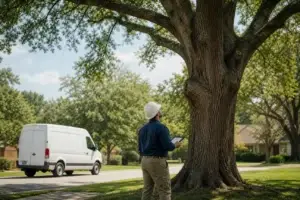
A tree risk assessment Weber County property managers can rely on starts with a simple but critical question: when does a tree stop being an asset and start being a liability? A thorough evaluation answers that question before an accident happens, giving commercial and multifamily property managers a documented, defensible basis for maintenance decisions. All Woods Tree Service performs professional tree risk assessments for office parks, apartment complexes, and retail properties throughout Weber County, helping managers protect residents, tenants, and their budgets.
What a Professional Tree Risk Assessment Weber County Evaluates
A proper tree risk assessment looks well beyond a quick visual glance. Certified arborists examine root structure and soil heaving, trunk cavities or cracks, canopy density and deadwood, lean angle, and the tree’s proximity to buildings, parking areas, and foot traffic. Each of these factors is scored to determine the likelihood of failure and the potential consequences if that failure occurs near people or property.
Warning Signs That Signal a Liability Tree
- Visible root damage, exposed roots, or soil lifting near the base
- Large dead branches or a thinning, one-sided canopy
- Cracks, cavities, or fungal growth on the trunk
- A noticeable lean that has developed or worsened recently
- Roots or branches interfering with sidewalks, roofs, or power lines
Why Weber County Property Managers Can’t Skip Risk Assessment
Commercial and multifamily properties carry higher liability exposure than a single-family yard simply because more people pass beneath the trees every day. If a hazardous tree fails and causes injury or property damage, an insurance carrier or attorney will ask whether the property manager had any record of inspection. A documented tree risk assessment from a certified arborist creates exactly that record, and it often satisfies the due-diligence requirements insurers expect from commercial policyholders.
How Often Should Risk Assessments Be Performed?
Most Weber County commercial properties benefit from an annual risk assessment, with additional inspections after major storms, high winds, or any visible change in tree condition. Properties with older, mature trees or a history of storm damage may need a more frequent schedule. All Woods Tree Service can build a recurring inspection calendar so nothing gets overlooked between visits.
From Assessment to Action: Removal, Trimming, or Monitoring
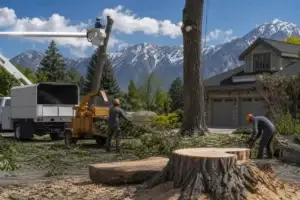
Not every flagged tree needs to come down. A risk assessment often leads to targeted tree trimming that removes the hazardous portion while preserving a healthy tree, or to a monitoring plan for trees showing early warning signs. When removal truly is the safest option, our tree removal crews handle the job with minimal disruption to tenants or daily operations. The U.S. Forest Service notes that regular hazard tree evaluation is one of the most effective ways to reduce tree-related injuries on managed properties.
Choosing a Qualified Provider for Tree Risk Assessment in Weber County
Not every tree service offers a true risk assessment. Look for a provider with ISA-certified arborists who use a documented rating system rather than a quick opinion. A proper report should list each tree evaluated, the specific defects observed, a risk rating, and a clear recommendation, whether that is removal, pruning, cabling, or ongoing monitoring. This level of documentation is what protects property managers when insurance carriers or legal counsel ask for proof of due diligence after an incident.
All Woods Tree Service has performed tree risk assessment work for office parks, apartment communities, and retail centers across Weber County cities including Ogden, Roy, Riverdale, and South Ogden. Our reports are written in plain language that property managers can bring directly to their board, ownership group, or insurance provider, and we’re happy to walk through the findings on-site so nothing gets lost in translation between the arborist’s notes and the decisions that need to be made.
If you manage commercial or multifamily property in Weber County, don’t wait for a failure to find out which trees are a risk. Contact All Woods Tree Service to schedule a professional tree risk assessment today.