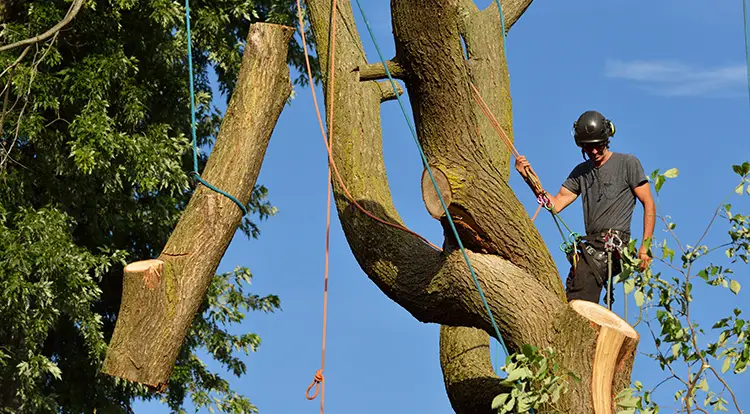
Topping trees is one of the most damaging practices a property owner or landscaping crew can perform, yet it remains common across Davis and Weber County. Topping trees may seem like a quick way to reduce height or manage overgrown branches, but the long-term damage to tree health and property value almost always outweighs any short-term benefit.
What Is Tree Topping?
Topping trees involves cutting large branches or the main trunk back to stubs, rather than pruning at a natural branch union. It is often used to reduce a tree’s height quickly, but it removes the leaf-bearing canopy the tree relies on for energy production and leaves large wounds that are slow to heal.
Why Topping Trees Damages Long-Term Health
- Removes the majority of a tree’s food-producing leaves, causing stress and starvation
- Creates large open wounds that invite decay, insects, and disease
- Triggers weak, fast-growing water sprouts that are prone to breaking
- Increases the risk of sunscald and further branch dieback
- Shortens a tree’s overall lifespan and structural stability
The Property Value Impact of Topping Trees
Topped trees are visibly disfigured for years, and the weakened branch structure they develop becomes a long-term liability. For HOA common areas and commercial properties in Davis and Weber County, topped trees can lower curb appeal, increase future removal costs, and create safety hazards from weakly attached regrowth that is more likely to fail in storms.
Better Alternatives to Topping Trees
Certified arborists use crown reduction, crown thinning, and selective tree trimming to safely manage size and shape while preserving a tree’s natural form and long-term health. These methods remove growth at proper branch unions, which allows the tree to heal correctly and maintain structural integrity. When a tree has already been severely topped in the past and is now hazardous, removal may eventually be the safest option.
Protecting Your Trees from Improper Pruning
Property managers and HOA boards should be cautious of landscaping crews who recommend topping trees as a routine service. According to the International Society of Arboriculture, topping is considered an unacceptable pruning practice for most species because of the long-term harm it causes. Working with an ISA certified arborist ensures pruning decisions protect both tree health and property value.
How to Spot Trees That Have Been Topped
Recognizing the signs of topping trees can help property managers and HOA boards catch the problem before it worsens. Look for stubbed branch ends with no natural taper, clusters of thin upright shoots sprouting from cut points, and a generally lopsided or flattened canopy shape. These signs indicate that topping trees has already occurred and that corrective pruning by a trained professional may be needed to gradually restore a safer branch structure over several growing seasons.
In Davis and Weber County, older residential subdivisions and some commercial landscapes still show the effects of topping trees performed years ago by unqualified crews. Correcting this damage takes patience, since removing all of the weak regrowth at once can shock an already stressed tree. A qualified arborist will typically thin out water sprouts gradually over multiple visits, allowing the tree to rebuild a stronger, more natural canopy while minimizing further stress. Because reversing the effects of topping trees can take several years of corrective care, prevention is always the better investment. Scheduling regular, professional pruning on a predictable seasonal calendar helps HOA boards and commercial property managers avoid the situation entirely, keeping trees healthy, structurally sound, and attractive without ever resorting to topping trees as a shortcut.
If trees on your Davis or Weber County property have been topped in the past or need a safer pruning approach, contact All Woods Tree Service for a professional evaluation.