Emerald ash borer can kill an ash tree before the damage looks severe from the ground. The right response depends on the tree’s size, health, location, and signs of decline. We’ll explain how treatment works, when trunk injections or soil treatments make sense, and when removal is the safer choice for your property.
What Emerald Ash Borer Is and How It Damages Ash Trees
Emerald ash borer treatment targets a small invasive beetle that attacks ash trees. The adult beetle is metallic green, but its larvae cause most of the harm. They feed beneath the bark and cut through the phloem and cambium, the living layers that move food and water through the tree.
Those feeding tunnels interrupt the tree’s internal flow. As the damage spreads, branches lose access to water and stored sugars. The crown thins. New shoots may grow from the trunk or larger limbs as the tree tries to replace lost branches.
The emerald ash borer’s life cycle includes adult beetles that lay eggs in bark crevices. After hatching, the larvae tunnel under the bark before emerging through small, D-shaped holes. Those holes are one of the clearest clues, though they may be hard to spot on a mature tree.
Look for several signs together:
- D-shaped exit holes in the bark.
- Thin or dying branches near the top of the crown.
- New shoots along the trunk or at the base of larger limbs.
- Splits in the bark above larval tunnels.
- Woodpecker activity on the trunk.
- Loose bark that reveals winding galleries beneath it.
A single symptom doesn’t prove infestation. Ash trees can thin out because of drought, root damage, poor soil, disease, or construction near the roots. We look at the whole tree before suggesting treatment.
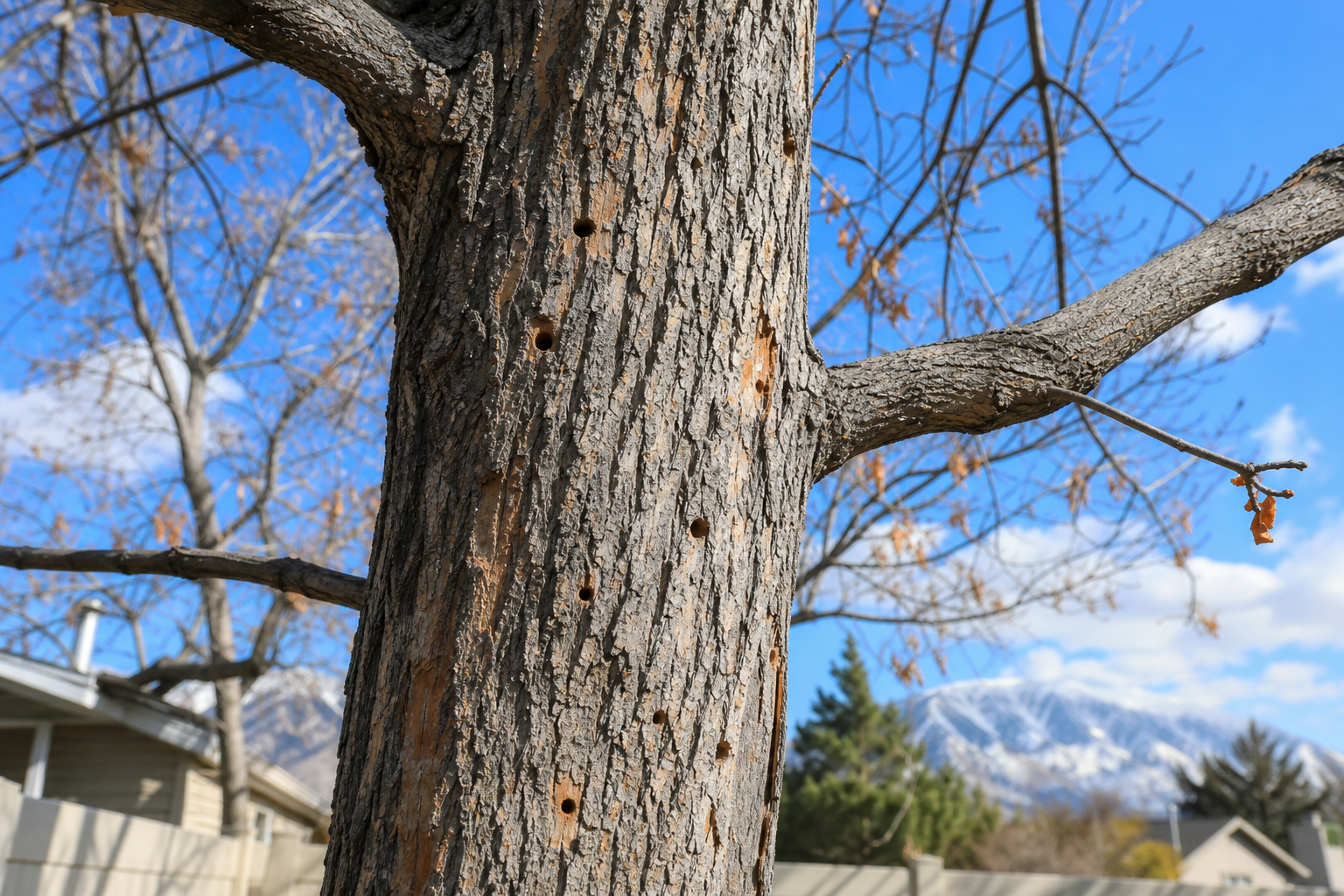
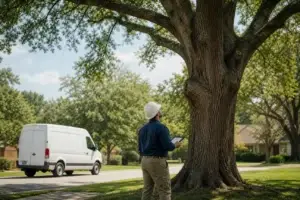
Timing matters because a tree with early damage may still respond well, while a tree with major canopy loss may have too little living tissue left to protect. The safest first move is a close inspection by an ISA-certified arborist or another qualified tree professional.
How to Tell Whether an Ash Tree Can Still Be Treated
Successful emerald ash borer treatment starts with a decision about viability. A living ash tree isn’t automatically a good treatment candidate. The tree must have enough healthy canopy and sound structure to keep growing after the insect pressure drops.
We begin with the crown. If most branches still hold healthy leaves, treatment may be worth discussing. If the upper crown is mostly bare, large limbs are dead, or the trunk has major cracks, treatment becomes less likely to pay off.
Next, we check the trunk and main limbs. Bark splits can expose galleries and weaken the wood. Large dead branches can fall even when the rest of the tree looks green. A tree near a roof, driveway, sidewalk, play area, or fence needs a stricter safety review.
Tree size also affects the plan. Professionals measure diameter at breast height, often called DBH. That means measuring the trunk at a standard height above the ground. DBH helps determine the treatment amount and whether a soil application is workable for that tree.
We also ask what stands below the tree. A declining ash in an open field has a different risk profile than one beside a home. If you aren’t sure about a large limb or a leaning trunk, our tree risk assessment service can help frame the safety decision before you spend money on treatment.
There isn’t one canopy-loss number that fits every tree. Species, age, drought stress, root damage, and the length of the infestation all change the outlook. A good assessment should explain both paths, treatment and removal, instead of assuming one answer before the inspection.
Emerald Ash Borer Treatment Options: Injections, Soil Treatments, and Sprays
Most professional emerald ash borer treatment plans use a systemic insecticide. The product enters the tree and moves through its vascular system. The best method depends on tree size, infestation level, soil conditions, and the label directions for the chosen product.
Trunk injections
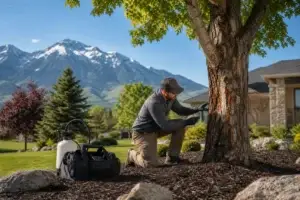
Trunk injections place a measured chemical dose into small ports in the trunk. The tree then moves the active ingredient upward. This approach puts the treatment into the tree instead of across a broad area of soil or foliage.
Injections often fit larger trees or sites where a soil treatment could affect nearby plants. They require the tree to move enough water for uptake. They also require the right equipment and skill. Poor placement, excess pressure, or repeated holes in the wrong spots can add stress.
Soil drenches and soil injections
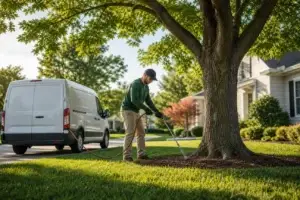
Soil treatments place systemic insecticide in the root zone. The roots take it up as the tree absorbs water. A soil drench may suit smaller trees with accessible, healthy soil. Compacted ground, heavy mulch, drought, or saturated soil can limit uptake.
Soil applications need careful attention near drains, wells, gardens, streams, and other plants. The product label controls where it can go and how it must be mixed. More product isn’t a better treatment. The dose should match the measured tree and the label.
Foliar sprays
Foliar sprays cover leaves and bark with an insecticide. They may help target adult beetles in some settings, but they don’t replace a systemic plan for larvae feeding under the bark. Spray work also raises exposure concerns near people, pets, pollinators, and edible plants.
Biological control is another part of the broader response to this pest. Researchers and public agencies have studied parasitoid wasps and other natural enemies. These efforts may reduce pest pressure across a region, but they aren’t a stand-alone rescue plan for one ash tree in a yard.
Emerald ash borer is an invasive threat to ash trees, and monitoring and control work can help limit its spread. That wider effort matters because untreated ash trees can keep adding beetles to the local area.
Treatment usually needs follow-up. Some plans call for repeat applications based on the product label, tree condition, and local pest pressure. We record the method and the tree’s response so the next visit isn’t based on guesswork.
When to Treat Emerald Ash Borer in Northern Utah
When to schedule emerald ash borer treatment depends on tree activity, weather, and the application method. Systemic products need the tree to take up and move the treatment. A drought-stressed tree may not absorb it well, even when the calendar looks right.
In Northern Utah, we generally want to assess ash trees before peak summer stress. Early spring can be useful for planning and inspection. Late spring or early summer may support uptake when the tree has active growth and adequate soil moisture. Exact timing still depends on the product label and the conditions at the site.
Don’t wait for a completely bare crown. Once much of the canopy has died, the tree has less living tissue to carry the treatment. A tree that looks fine can also carry an early infestation, so routine checks make more sense than waiting for dramatic symptoms.
Before treatment, we check soil moisture and recent weather. We also look for grading work, trenching, irrigation changes, or construction near the root zone. These issues can weaken an ash tree and may need attention alongside insect control.
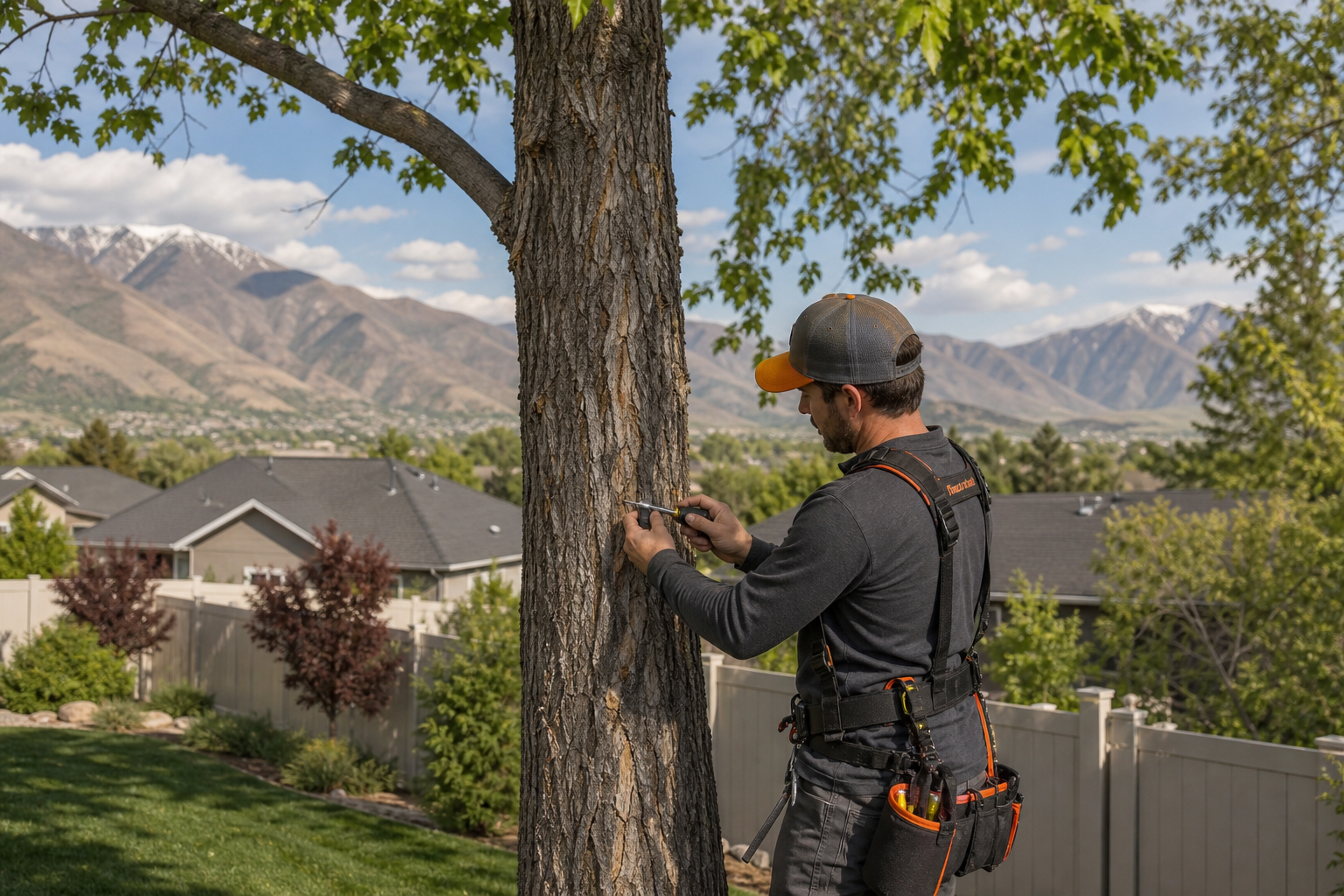
Property owners should plan for monitoring after the first application. New leaves may not appear overnight, and old dead branches won’t turn green again. The useful signs are continued live growth, stable crown condition, and less new damage over time.
Tree care can also include soil improvement when the roots are stressed. Our guide to deep root fertilization in Davis and Weber County explains how a nutrient mix can be placed in the root zone. Fertilization doesn’t kill emerald ash borer, but better root care may support a tree that is still a treatment candidate.
For a property with several ash trees, make a simple map. Note each tree’s location, trunk size, canopy condition, and nearby targets such as buildings or parking areas. That lets an HOA or property manager set priorities before an emergency forces a rushed choice.
Treatment or Removal: Protecting Your Property and Nearby Trees
Choosing treatment or removal is a risk decision, not a beauty contest. Emerald ash borer treatment may protect a tree with good structure and enough live canopy. It won’t restore wood that has already decayed or make a dangerous limb safe.
Removal becomes more reasonable when the tree has severe crown loss, large dead branches, trunk decay, a major lean, or a target that can’t be protected. A tree beside a home or busy walkway deserves a lower tolerance for failure than one in a distant part of a lot.
Nearby ash trees need attention too. If one tree shows signs of infestation, inspect the others. Treating only the most damaged tree may leave healthier ash trees exposed. At the same time, don’t treat every tree without confirming its species, condition, and suitability for the method.
Removal has its own work plan. We first assess access and overhead hazards. Then we choose a lowering path for limbs, protect the surface below, and leave the site safe for people and equipment. Afterward, stump grinding can remove most of the visible stump and reduce the obstacle for future yard work.
All Wood’s Tree Service, Inc. works with homeowners, HOAs, property managers, and commercial clients across Northern Utah. We can discuss treatment when preservation makes sense, then handle safe removal when the tree has become a property risk. Free estimates help you compare the next step without making a decision from a rushed bid.
If removal is urgent after a storm or sudden failure, we provide 24-hour emergency cleanup. Serving Northern Utah since 1995, our focus is clear: protect the people, buildings, and plants that share the site.
Frequently Asked Questions About Emerald Ash Borer Treatment
Can an ash tree survive emerald ash borer?
Yes, an ash tree may survive when treatment starts early and the tree still has healthy canopy and sound structure. Insecticide can reduce new damage, but it can’t repair decay or replace dead limbs. A professional should inspect the crown, trunk, roots, and nearby hazards before calling the tree a treatment candidate.
What is the most effective emerald ash borer treatment?
Trunk injection is often effective for suitable ash trees because it places a measured systemic product inside the tree. Soil treatments can fit smaller trees with healthy root access. The best choice depends on tree size, condition, soil, and the product label. No method works well for a severely unsafe tree.
How do I know if my ash tree has emerald ash borer?
Look for D-shaped exit holes, thinning leaves, woodpecker activity, bark splits, and new shoots on the trunk. These clues can have other causes, so they don’t prove an infestation by themselves. An arborist can inspect the bark and crown, confirm whether the tree is ash, and assess damage before treatment.
Can I treat emerald ash borer myself?
Some products are sold for homeowner use, but DIY treatment still requires correct tree measurement and strict label use. A wrong dose or poor application can harm the tree and nearby plants. Professional help makes more sense for large trees, trees near buildings, or sites with wells, drains, gardens, or public access.
When should an ash tree be removed instead of treated?
An ash tree should be considered for removal when it has major trunk decay, severe canopy loss, large dead limbs, or a dangerous lean. Treatment controls insects, not structural failure. We recommend a site review when the tree stands near a home, road, fence, parking area, or walkway.
Conclusion
Have an ash tree inspected before the canopy declines further. If it has enough healthy growth, a measured injection or soil treatment may protect it. If the structure is unsafe, removal is the better choice. All Wood’s Tree Service, Inc. can provide a free estimate and help you plan the next step for your Northern Utah property.