Northern Utah is no stranger to dry summers, but the conditions we are seeing right now are among the most severe in recent memory. Prolonged drought, record-breaking heat, and active wildfires across the state have created a dangerous environment for homeowners, and for the trees and landscaping surrounding their properties. If you live in Northern Utah and have mature trees on your property, now is the time to take action. Waiting could cost you far more than a trimming bill. It could cost you your insurance coverage, your landscaping, or even your home.

Utah’s Drought Crisis: What Homeowners Need to Know
Utah is one of the driest states in the nation, and recent years have pushed that reality to a critical tipping point. The Great Salt Lake has reached historic low levels, mountain snowpack has fallen well below average in many seasons, and communities across Northern Utah, including Ogden, Logan, Brigham City, Layton, and the Wasatch Front, have faced mandatory water restrictions and extreme fire danger ratings.
When soil moisture drops to dangerously low levels, trees become stressed. Stressed trees are more susceptible to disease, insect infestation, and structural failure. Dead or dying branches become tinder. Overgrown canopies that once looked lush can become a serious fire hazard when they dry out, especially when they extend over rooftops, fences, power lines, or neighboring structures.
The Utah Division of Forestry, Fire and State Lands has issued elevated fire danger warnings across much of Northern Utah, urging residents to take proactive steps to reduce fire risk around their homes and properties. One of the most impactful steps you can take as a homeowner is proper tree care and maintenance.
Wildfires in Utah: The Threat Is Closer Than You Think
According to KSL News, 2025 was described as an ‘insane’ year for Utah wildfires, and fire experts warn the threat is not easing in 2026. Utah’s wildfire season has grown longer and more intense. Fires that once burned primarily in remote areas are now threatening the wildland-urban interface, the zones where developed neighborhoods meet undeveloped forests, foothills, and grasslands. Communities in Cache Valley, Weber County, Box Elder County, Davis County, and throughout the Wasatch Front sit squarely in these high-risk zones. A KSL News report on the cost of Utah’s 2025 wildfire surge highlighted just how significant the financial and structural damage has become across the state.
When a wildfire moves toward a neighborhood, embers can travel hundreds of feet ahead of the fire line, landing on rooftops, decks, and critically overhanging trees and branches. A single dry branch hanging over a roofline can serve as a bridge that carries fire directly onto your home. Fire-safe landscaping and proactive tree trimming are recognized by fire safety experts as among the most effective defenses a homeowner can implement. The National Interagency Fire Center projects an active 2026 wildfire season for the West due to below-average precipitation.

The concept of “defensible space,” the buffer zone you create between your home and the surrounding vegetation, is a core fire safety strategy. Trees that overhang your roof, crowd your gutters, or press against your siding eliminate that defensible space and dramatically increase the risk of your home igniting during a wildfire event. KSL News has also reported on how overgrown vegetation near Utah communities is being surveyed for wildfire threats.
Why Overhanging Trees Are an Insurance Liability in Northern Utah
Here is something many Northern Utah homeowners do not realize until it is too late: having trees that hang over your home can cause your homeowner’s insurance company to drop your coverage, or refuse to renew your policy.
Insurance companies assess risk when they issue or renew homeowner policies. Trees with branches overhanging a roof represent multiple, significant risks in their eyes:
- Fire risk: Overhanging branches and accumulated leaf litter in gutters create a direct ignition pathway to your home during a wildfire or even a simple chimney spark.
- Storm damage risk: Dead, dying, or overgrown limbs can fall on a roof during high winds, a common occurrence in Northern Utah’s mountain corridors and canyon-fed wind events.
- Structural damage risk: Branches rubbing against shingles cause chronic abrasion and moisture infiltration. Roots near foundations can compromise structural integrity over time.
- Liability risk: If a tree on your property falls on a neighbor’s home or vehicle, you may be held liable, particularly if the tree showed signs of poor maintenance.
Insurance underwriters in Utah, particularly following major regional wildfire events, are conducting more frequent property inspections and reviewing aerial imagery. If they identify overhanging trees, dead limbs over structures, or unmaintained canopies, they can issue non-renewal notices or require remediation before your policy reinstates. In some cases, homeowners have received cancellation notices with as little as 30 days to correct the issue.
The bottom line: regular tree trimming is not just good landscaping practice. In today’s insurance environment, it is a financial necessity for Northern Utah homeowners.
Protecting Your Trees and Landscaping During Utah’s Dry Season
Beyond fire risk and insurance concerns, Utah’s prolonged dry weather takes a direct toll on trees and landscaping. Trees that appear healthy on the outside may be under severe internal stress due to drought conditions. Here are the key steps Northern Utah homeowners should take right now to protect their investment:

1. Schedule a Professional Tree Inspection
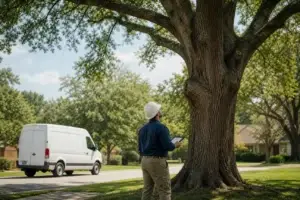
A certified arborist can identify signs of drought stress, disease, pest infestation, and structural weakness that are not visible to the untrained eye. Research also shows that strategic tree thinning benefits both wildfire protection and water conservation in Utah. Trees that appear stable may have compromised root systems or internal decay that makes them dangerous during high winds or fire conditions. In Northern Utah, common concerns include bark beetle infestations in pines, fire blight in fruit and ornamental trees, and root rot exacerbated by drought-cracked soil.
2. Prioritize Tree Trimming and Canopy Management
Regular tree trimming serves multiple purposes during dry, fire-prone conditions. Removing dead, dying, and crossing branches reduces fire fuel load, improves the structural integrity of the tree, and eliminates the overhanging limbs that put your insurance coverage at risk. Canopy thinning also reduces the weight load on major limbs, lowering the risk of branch failure during storm events.
For homes in Northern Utah, arborists generally recommend maintaining a minimum clearance of 10 feet between tree canopies and rooflines, and ensuring no branches directly overhang the structure. This is especially important for homes near the foothills in areas such as North Ogden, Pleasant View, Harrisville, Farr West, Perry, Willard, and the communities along the Wasatch Front bench.
3. Deep Water Your Trees
During drought conditions, supplemental deep watering is one of the most effective ways to keep trees healthy and reduce their susceptibility to fire and disease. Surface watering is ineffective for mature trees, water needs to penetrate 12 to 18 inches into the soil to reach the root zone. Slow, deep watering sessions once every two to three weeks during the hottest months can make a measurable difference in tree health and resilience.
4. Mulch Around the Base of Trees
Applying a 3- to 4-inch layer of wood chip mulch around the base of trees (keeping it several inches away from the trunk) helps retain soil moisture, regulate soil temperature, and reduce water evaporation. This is a simple, low-cost step that can significantly extend the time between waterings and reduce heat stress on root systems.
5. Remove Dead Trees and Hazardous Wood
Dead standing trees, also called snags, are a serious hazard in fire-prone areas. They ignite quickly and burn intensely. If you have dead trees on your property, particularly near structures, fences, or property lines, removal should be treated as urgent. The same applies to large dead limbs still attached to otherwise healthy trees. Do not wait until the next storm brings them down onto your roof or a neighbor’s vehicle.

The All Woods Tree Service Difference: Expert Tree Care in Northern Utah
At All Woods Tree Service, we have been serving Northern Utah homeowners and property managers with professional tree care for years. Our team understands the unique demands of Utah’s climate: the extreme temperature swings, the persistent drought cycles, the wind events that funnel through our mountain canyons, and the increasing wildfire threat that comes with each passing summer.
We provide comprehensive tree services designed to protect your property, preserve your insurance coverage, and keep your landscaping healthy through even the toughest dry seasons:
- Tree Trimming and Pruning: Precision trimming to remove overhanging branches, deadwood, and structurally compromised limbs, with clearance from rooflines and structures that satisfies insurance requirements.
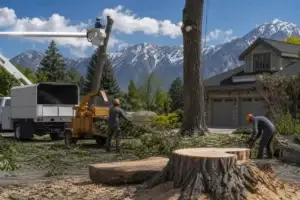
- Tree Removal: Safe, efficient removal of dead, diseased, or hazardous trees, including stump grinding to eliminate trip hazards and prevent pest harborage.
- Emergency Storm Services: Rapid response to wind and storm damage across Northern Utah.
- Tree Health Consultations: Expert assessments of drought stress, disease, and pest issues affecting your trees.
- Firewise Landscaping: Strategic vegetation management to create defensible space and reduce your property’s wildfire ignition risk.
We serve homeowners throughout Weber County, Box Elder County, Cache County, Davis County, and the surrounding Northern Utah communities. Whether you are in Ogden, Logan, Brigham City, Layton, Kaysville, Bountiful, North Ogden, Roy, or the surrounding mountain communities, our team is equipped to handle jobs of any size with professionalism and care.
Do Not Wait Until You Receive an Insurance Notice, or See Smoke on the Horizon
The combination of extreme drought, active wildfire seasons, and increasingly risk-conscious insurance underwriters has created a new reality for Northern Utah homeowners. The trees on your property are assets, but only if they are properly maintained. Neglected trees, particularly those with branches overhanging your home, have become one of the most common reasons homeowners in Utah are losing their insurance coverage or facing costly claims.
Do not let that happen to you. A professional tree trimming appointment is a small investment compared to the cost of a dropped insurance policy, a fire-damaged roof, or the loss of a decades-old tree that could have been saved with timely care.
Contact All Woods Tree Service today for a free estimate. Our experienced team will assess your property, identify risk areas, and provide the expert tree care Northern Utah homeowners trust. Call us or fill out our contact form on this page, and let us help you protect what matters most before the next fire season peak arrives.
All Woods Tree Service proudly serves Northern Utah including Ogden, Logan, Brigham City, Layton, Kaysville, Bountiful, North Ogden, Roy, Perry, Willard, Farr West, Harrisville, Pleasant View, and surrounding Weber, Box Elder, Cache, and Davis County communities. Contact us today for professional tree trimming, tree removal, and tree health services.